

The Cup, the Coffee, and the Secret of Zero: How We Actually Think in Numbers
When we sit down to learn mathematics, we are often handed a “cup” and told it is the “coffee.” We get lost in the symbols—the $1, 2, 3$, and the mysterious $10$—forgetting that these are just containers for a much deeper reality.
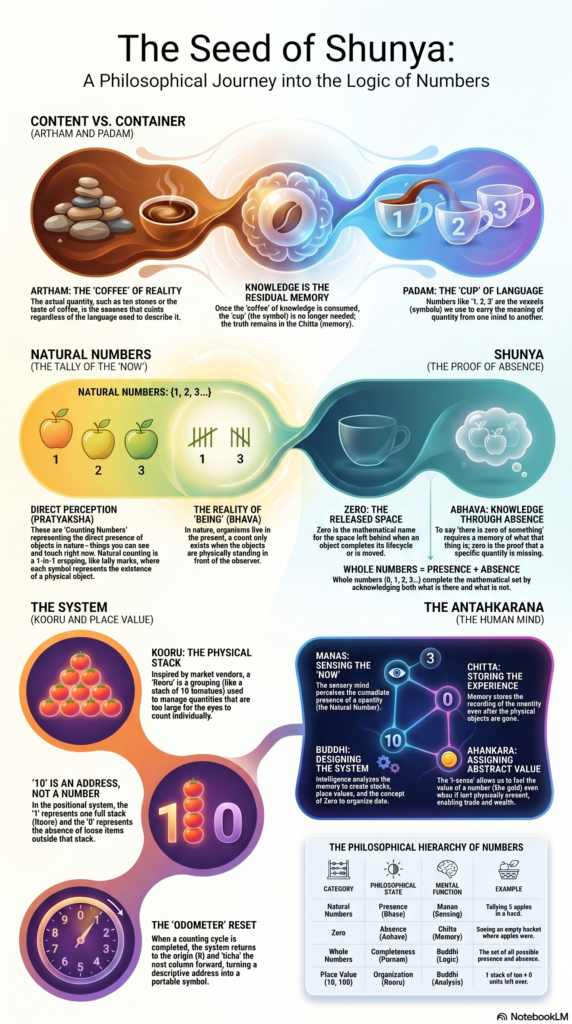
At Harivulagam, we believe that to understand math, we must first understand the human mind (Manas) and how it perceives the world.
1. The Coffee and the Cup
Imagine a Guru welcoming his students. He pours coffee from a single flask into many different vessels: a silver tumbler, a clay cup, a glass jar.
The students realize a profound truth: the Content (Artham) is the coffee. It provides the taste and the happiness. The Container (Padam) is just the language used to transfer that coffee from the flask to the student.
In mathematics, the “Quantity” is the coffee. The “Numbers” ($1, 2, 3…$) are just the cups. Once you “taste” the quantity and understand it, the symbols are no longer needed. You carry the happiness of knowledge in your memory (Chitta) long after the cup is set aside.
2. Counting is the “Now”
For most living organisms, life happens only in the Now. A bird sees three eggs; it doesn’t “calculate” them. It simply perceives their presence (Pratyaksha).
We call these Natural Numbers. They are the tally marks of existence. One stone, one tally. Ten stones, ten tallies. This is the “Natural” way of being.
3. The Invention of the “Kooru” (The Stack)
As humans, our analytical mind (Buddhi) realized that counting forever is impossible. If we have a thousand tomatoes, we cannot keep them all in our “Now.”
So, we organize them. We create a Kooru (a stack). In the markets of Tamil Nadu, you see this every day—grouping objects into pairs, fives, or tens. This physical stacking was the birth of the Base System.
4. Zero: The Proof of Absence
This is where the genius of our ancestors shines. They understood Abhava—the knowledge of non-existence.
When you take ten loose tomatoes and put them into one solid “Kooru” (stack), the space where the loose tomatoes used to be is now empty. To write the number 10, we aren’t writing a new number. We are writing a code:
- 1: One complete stack exists.
- 0: There is an absence (Abhava) of any loose items left over.
Zero is the “Singapore Shoppe” of our memory—a landmark that tells us where we started so we don’t get lost when we trace our way back to the origin.
5. Why Humans Need Math
Other animals have Ahara (food) and Nidhra (sleep), but only humans have the Antahkarana (the inner mind).
- Manas senses the object.
- Chitta stores the memory of it.
- Buddhi organizes it into a system.
- Ahankara allows us to feel the value of that object even when it’s gone.
Conclusion
Numbers were not invented by scientists in labs; they were invented by people in markets who wanted to “trace back” the value of their goods. Math is the language we use to talk about things when they aren’t there anymore.
The next time you look at a math problem, don’t just look at the symbols. Ask yourself: “What is the coffee here? What is the reality this cup is trying to carry?”
Welcome to a new way of seeing. Welcome to the world of knowledge.
For more deep dives into the logic of our existence, stay tuned to Harivulagam.com.

Leave a Reply