We celebrate the conquerors. We build statues of men holding Swords. But look closer at history, and you’ll find a terrifying pattern:
The Sword only works as long as the arm is strong. The moment the arm tires, the Sword is just a piece of cold, heavy iron. But a Word? A Word is a virus. It enters the ear, nests in the brain, and replicates. You can’t kill a Word with a blade. In fact, the more you try to cut it down, the faster it spreads.
The Question That Lingers
Alexander left India empty-handed. Ashoka died a monk. Gandhi died a martyr. They all started with the power of the metal, but ended with the power of the breath.
The “Sword vs. Words” Anxiety Test: Next time you are in a conflict, ask yourself:
Are you reaching for the Sword because you are powerful?
Or are you reaching for it because you are terrified of what the Word might reveal about you?
“A Sword can end a life. A Word can end an Era. Choose your weapon, but remember—only one of them survives the grave.”
“If you live by the Sword, you die by the Sword. But if you live by the Word, you never truly die at all—you just become a story someone else has to figure out.”
Coming up next: We dive into the “Silent Swords”—the hidden meanings behind India’s most ancient symbols.
Episode 4: The Silent Revolution (The Modern “S” – Satyagraha)
The Setup: A massive empire with machine guns vs. a man with a wooden stick and a vow of silence.
The Anxiety: This is the “Anxiety of the Unarmed.” How do you fight someone who refuses to hit you back? The British military was trained to handle a Sword, but they were terrified of a Word (Satyagraha).
The Twist: When the “S” moves from Sword to Words, it creates a vacuum. The Word doesn’t kill the enemy; it kills the enemy’s justification for existing. That is a much more painful death for an empire than any battlefield loss.
A modern conclusion to the series that brings the philosophy into the 20th century.
The Sword: The British Empire, the greatest military force of its time, equipped with modern rifles, cannons, and laws.
The Word: A man in a loincloth (much like the Gymnosophists Alexander met) who used the word Satyagraha (Truth-Force).
The Victory: Gandhi didn’t pick up a sword to fight the Salt Tax. He walked to the ocean and picked up a grain of salt. He used the Word to mobilize millions.
The Verdict: As Gandhi famously said, “In a gentle way, you can shake the world.” The British “Sword” became heavy and useless because they had no moral “Word” to justify their rule anymore.
Episode 3: The Poet and the Tyrant (The Legend of Vikramaditya)
In Indian folklore, King Vikramaditya represents the “Just Sword,” but he is always tested by the “Wise Word.”
The Sword: Vikramaditya was a mighty warrior king, capable of vanquishing any physical foe.
The Word: He is most famous for his encounter with the Vetal (the ghost in the tree). The Vetal tells him 24 complex stories. After each story, the Vetal asks a riddle. If the King knows the answer but stays silent, his head will burst; if he speaks, the Vetal escapes.
The Victory: The King’s power meant nothing in the graveyard. Only his discernment, patience, and wisdom allowed him to complete his task.
The Verdict: Force can capture a kingdom, but only Truth can capture a Vetal. The series of stories (Vetala Panchavimsati) proves that a King’s greatest weapon isn’t his armory, but his judgment.
The Setup: Imagine standing in a river that is no longer water, but a thick, warm soup of your own making. Ashoka stood in the Daya River after the Kalinga war. He had the Sword. He had “won.”
The Anxiety: The silence after a massacre is louder than the screaming during it. The “Word” that broke Ashoka wasn’t a long speech; it was a reflection. A monk looked at the Emperor—the most powerful man in the world—and asked a question that induces existential dread:
“You have conquered thousands, but can you conquer the one man standing in your shoes?”
The Twist: Ashoka realized the Sword is a lie. It promises security but delivers a graveyard. He spent the rest of his life frantically carving words into stone—Ashoka’s Edicts—as if trying to bury the sound of the swords forever.
This is the most literal transformation of Sword to Word in history.
The Sword: Ashoka’s conquest of Kalinga was so brutal that the Daya River reportedly turned red with the blood of 100,000 slain. He stood on the battlefield as the ultimate victor.
The Word: Walking among the corpses, Ashoka met a Buddhist monk (or, in some versions, saw the silent suffering of the survivors). A simple realization—the Word of Dhamma—pierced his heart deeper than any blade.
The Victory: Ashoka didn’t just stop fighting; he replaced his army with “Dhamma-Mahamatras” (Officers of Righteousness). He carved his Words into stone pillars across Asia.
The Verdict: The Maurya swords have rusted away, but Ashoka’s Wheel (the Dharmachakra) sits at the center of the Indian flag today. The Word outlasted the Empire.
In 326 BCE, the unstoppable Sword of Macedonia reached the banks of the Jhelum. Alexander the Great had toppled empires and redrawn the maps of the world. But in India, he encountered an enemy he couldn’t slash: the Gymnosophists—sages who wore nothing but the truth.
The Ten Riddles of Survival
Alexander captured ten of these “Naked Sages” who had incited local resistance. He decided to play a game of wits, promising that the one who gave the worst answer would be executed first, with the eldest acting as the judge.
On Life and Death: When asked whether the living or the dead were more numerous, a sage replied: “The living, for the dead no longer exist.”
On the Greatest Beast: When asked which animal is the most cunning, the reply was: “The one which man has not yet discovered” (implying the beast within).
On Sovereignty: Alexander asked how a man might be most loved. The sage replied: “By being the most powerful, and yet not inspiring fear.”
On Day and Night: As we discussed, the sage claimed Day was older by one day, proving that hard questions require hard answers.
The Judgment: Where the Sword Folds
When the questions ended, Alexander turned to the eldest sage to judge who had given the worst answer. The sage smiled and said:
“Each has answered worse than the other.”
By refusing to rank the answers, the sage rendered Alexander’s threat of execution impossible to carry out without being illogical. The Sword was ready to strike, but the Word had tied Alexander’s logic in a knot.
Conclusion: Why the Word Wins
Alexander entered India believing that power was measured by how much land a man could seize. He left realizing that power was measured by how much a man could renounce.
The Sword can take a life, but it cannot change a mind. The Word, however, travels across centuries. Alexander’s empire crumbled within years of his death, but the words of the Indian sages—the philosophy of detachment and the pursuit of inner truth—remain alive on sites like yours today.
In the battle of Harivulagam, the “S” moved: the Sword was sheathed, and the Word became the legacy.
Philosophy without practice is just entertainment.
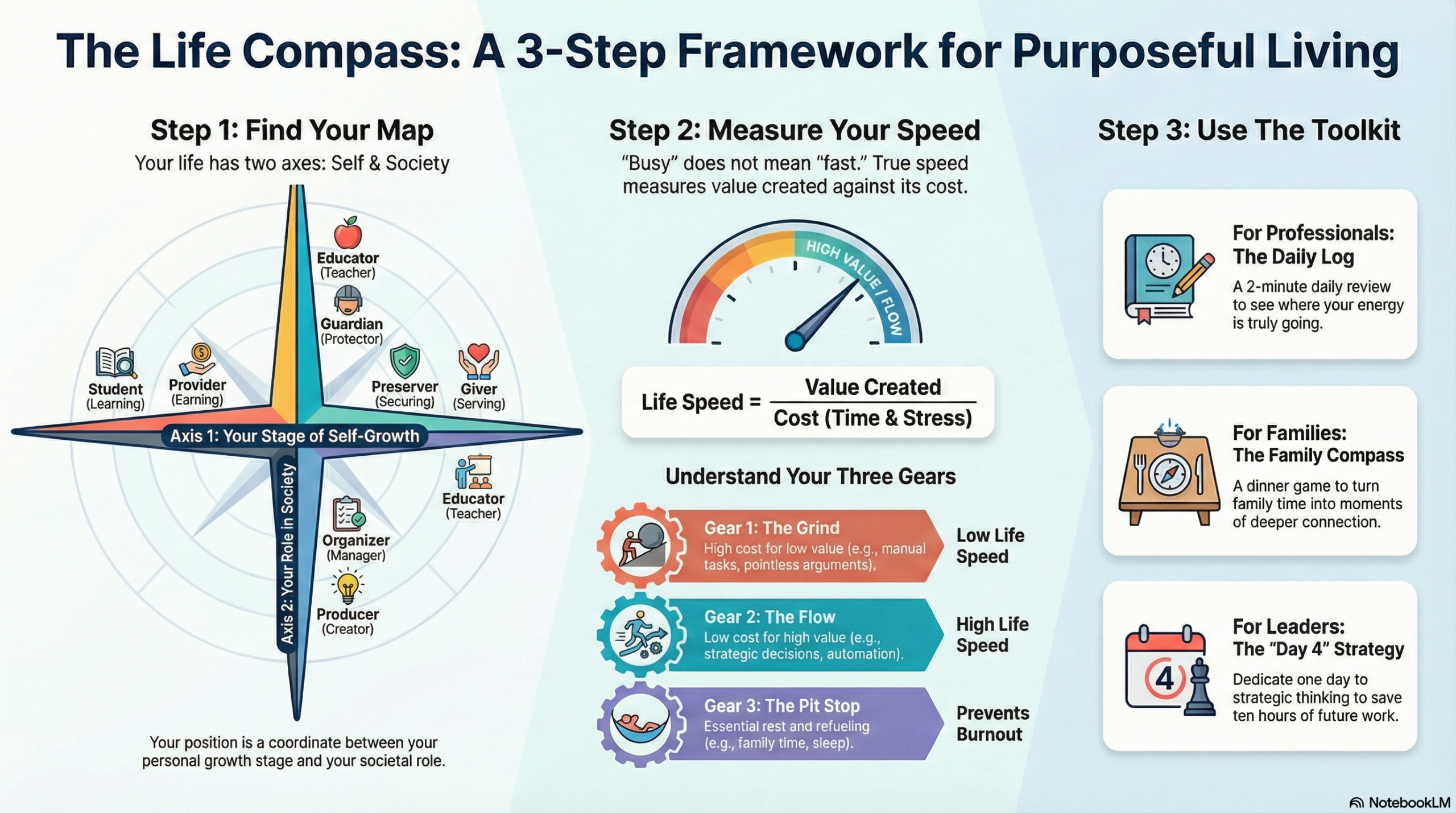
Over the last two weeks, we explored the Life Compass Map (Part 1) and the Physics of Life Speed (Part 2). Now, we hand you the tools to navigate.
Here are three templates designed for different aspects of your life. You don’t need an app or a spreadsheet. A simple notebook or the back of an envelope is enough.
Tool 1: The Professional’s Daily Log
For the career-focused individual who wants to escape “The Grind.”
At the end of your workday, take 2 minutes to fill out this simple table. It acts as a mirror, showing you where your energy is actually going.
How to use it:
Role: Were you a Producer (Doing), Organizer (Managing), or Student (Learning)?
Intensity: Score your focus from 1-10.
The Insight: If you see a week full of “Score 3” (Low Intensity), you are drifting. If you see 100% “Organizer” roles and 0% “Student,” you are burning out. Schedule time to learn.
Tool 2: The Family Compass
For turning vacations and weekends into deep connection.
Family trips often become stressful because we focus on logistics (tickets, food, traffic) rather than roles. Use this game at the dinner table.
The Dinner Table Game:
Ask each person: “What role did you play today?”
The Explorer: Did you find a new path or a new restaurant?
The Builder: Did you build a sandcastle or a plan?
The Peacemaker: Did you solve a problem between siblings?
The Guide: Did you teach us something new?
Why it works: It teaches children (and adults) that their value isn’t just “being there”—it’s about how they contribute to the group’s happiness.
Tool 3: The “Day 4” Strategy
For Leaders and Entrepreneurs.
If you are leading a project or a business, you cannot run at full speed every day. You need a Strategic Pause. We call this the “Day 4” rule (based on a 5-day work week).
The Protocol:
Dedicate one day (or half a day) exclusively to Design, Not Doing.
The “Anti-Scope” List: Write down what you will not do next week.
The One Metric: Identify the single number that defines success.
The Pre-Mortem: Ask, “What is most likely to kill this project?” and solve it before you start.
One hour of thinking on this day saves ten hours of fixing next week.
Final Thoughts
The Life Compass is not about reaching the destination faster. It is about ensuring that the path you are walking is your own.
In Part 1, we learned how to find our coordinates on the map of life. We identified whether we are Learners, Providers, or Givers, and how we contribute to society.
But knowing where you are is only half the battle. The second half is knowing how fast you are moving toward your destination.
In our modern world, we have a dangerous misconception. We believe that Speed = Activity. We think that if we are sweating, stressed, and working 12 hours a day, we must be moving fast.
Physics—and economics—tells us a different story.
The Physics of Life Speed
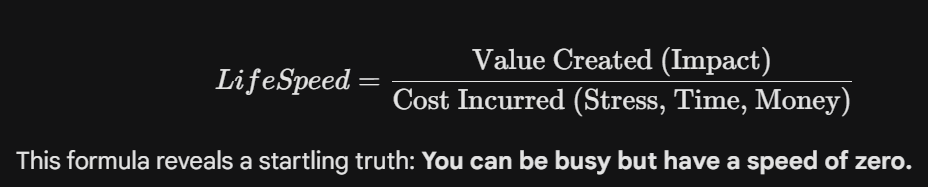
In traditional physics, speed is distance divided by time (1$v = d/t$).2 But in the journey of life, “Time” is actually a Cost. It represents the hours you burn, the stress you endure, and the health you sacrifice.
So, let us rewrite the formula for Life Speed:
This formula reveals a startling truth: You can be busy but have a speed of zero.
Scenario A (The Grind): You work for 10 hours manually copying data into a spreadsheet. You are exhausted.
Value: Low (Data entry).
Cost: High (10 hours + Back pain).
Result:Low Life Speed.
Scenario B (The Leverage): You spend 1 hour writing a script to automate that data entry forever.
Value: High (Permanent solution).
Cost: Low (1 hour).
Result:High Life Speed.
The Three Gears of Your Engine
To master this physics, you must recognize which “Gear” you are driving in each day.
Gear 1: The Grind (Low Speed)
This is when you trade your time directly for money or results, often inefficiently.
Signs: “I have too many emails,” “I am constantly putting out fires,” “I am tired but accomplished nothing.”
The Trap: Staying in this gear makes you feel like a martyr. You feel noble because you are suffering, but you aren’t actually moving the family or business forward.
Gear 2: The Flow (High Speed)
This is High Leverage. It happens when you make decisions, build systems, or deepen relationships.
Signs: “I solved a problem today that won’t come back,” “I had a conversation with my child that changed their perspective,” “I automated a task.”
The Goal: Successful people don’t work more hours; they spend more of their hours in Gear 2.
Gear 3: The Pit Stop (Refuel)
This is where many ambitious people fail. They think resting is “Zero Speed.”
The Truth: If you don’t stop to refuel (Sleep, Family Time, Meditation), your engine breaks. A broken engine has a speed of zero forever.
Action: When you are with family, be 100% there. That is not “lost time”; it is “durability maintenance.”
The Daily Speed Check
Tonight, instead of asking “What did I do today?”, ask yourself: “What was the cost of my progress?”
Did you achieve a small result at a huge emotional cost? (Slow down).
Did you achieve a massive result with a calm mind? (Keep going).
In Part 3, the finale of this series, we will give you the actual Toolkit—three simple templates you can use to track your Purpose and Speed in just 5 minutes a day.
Most of us live life like travelers without a map. We work hard, we study, we earn money, and we take care of our families. Yet, in the quiet moments—perhaps during a morning commute or late at night—we ask ourselves a haunting question:
“Am I in the right place? Am I actually moving forward, or am I just running in circles?”

We often confuse activity with progress. We think being “busy” means we are succeeding. But if you run at full speed on a treadmill, you are busy, yet you haven’t traveled a single inch.
To find your purpose, you don’t need to work harder. You need to know where you are standing. You need a map.
Welcome to The Life Compass.
The Two Axes of Existence
Ancient wisdom and modern economics agree on one thing: Life is an intersection of Time (your personal growth) and Space (your contribution to society).
To build our map, we split life into two simple axes.
Axis 1: Living for Self (The Journey of Time)
This axis represents your internal evolution. It is the chronological timeline of your life, divided into four distinct stages.
The Student (Preparation):
Goal: To Learn.
Focus: You are an “input” machine. You absorb skills, wisdom, and capacity. You are preparing the engine for the road ahead.
The Family Member (Execution):
Goal: To Earn.
Focus: You are the engine. You convert your energy into security for yourself and your dependents. This is the stage of “output” and responsibility.
The Retiree (Transition):
Goal: To Secure.
Focus: You move from accumulation to preservation. You organize your assets so you are not a burden, freeing your mind for higher things.
The Giver (Surrender):
Goal: To Give.
Focus: You detach. Your resources, wisdom, and time flow outward to society without expectation of return.
Axis 2: Living for Others (The Role in Society)
Regardless of your age, you must play a role in the wider world. Society functions because of four specific groups of people.
The Producers (Creators):
These are the hands of society. They build, code, grow food, and create tangible value. Without them, there is nothing to consume.
The Organizers (Merchants):
These are the circulatory system. They connect supply with demand, manage businesses, and ensure wealth flows efficiently.
The Administrators (Guardians):
These are the protectors. They create order, enforce laws, and manage systems so that producers and organizers can work safely.
The Educators (Guides):
These are the intellect. They teach, research, heal, and pass wisdom to the next generation of “Students.”
The Matrix: Where Do You Stand?
When we cross these two axes, we get the Life Matrix. Your “Purpose” at any given moment is simply the coordinate where you currently stand.
Let’s look at two examples:
The “B-2” (Provider-Organizer):
This is the entrepreneur or manager in the prime of their career. They are in the Family Stage (earning for security) and playing the Organizer Role (managing resources).
The Danger: Getting stuck here forever. The “Golden Treadmill” of earning more but never transitioning to giving.
The “A-1” (Student-Producer):
This is the young apprentice or engineering student. They are learning (Student) how to build things (Producer).
The Danger: Impatience. Trying to “Earn” before they have truly “Learned.”
The Diagnostic: Check Your Coordinates
This week, I invite you to stop running for five minutes and check your GPS.
Ask yourself two questions:
Internal Check: Which stage dominates my mindset right now? Am I still learning (Student)? Am I grinding for security (Family)? Or am I ready to share (Giver)?
External Check: How do I contribute to the world? Do I create (Producer), manage (Organizer), protect (Admin), or teach (Educator)?
Write down your coordinate (e.g., “Family-Organizer”).
Once you know where you are, the next question is: How fast are you moving toward the next stage?
In Part 2 of this series, we will discuss the physics of “Life Speed”—and why working 12 hours a day might actually be slowing you down.
Subtitle: A Framework to Measure Purpose, Speed, and Fulfillment in a Modern World.
Part 1: The Map – Finding Your Coordinates
Publish Date: Week 1
Headline: Are You Moving Forward or Just Moving?
The Hook:
Most people live life like a traveler without a map. We work hard, we earn money, we study, but often we feel lost. We ask, “Am I in the right place?” Today, we introduce a simple framework to locate exactly where you are in the journey of life.
1. The Two Axes of Life
Life isn’t a straight line; it’s a grid. To find your purpose, you need to look at two dimensions:
Axis 1: Living for Self (Time): This is your internal journey.
Student: Learning and absorbing.
Provider: Earning and supporting the family.
Preserver: Securing assets and retirement.
Giver: Detaching and serving society.
Axis 2: Living for Others (Space): This is your contribution to society.
Producer: Making things.
Organizer: Managing resources.
Guardian: Protecting order.
Educator: Sharing wisdom.
2. The Life Matrix
(Insert the 4×4 Matrix Diagram here)
When you cross these lines, you find your “Coordinate.”
Are you a Provider-Organizer (B-2)? You are the engine of the economy, but are you burning out?
Are you a Student-Producer (A-1)? You are building the skills to create.
3. The Trap
The danger is getting stuck in one coordinate (like “Provider-Organizer”) forever. The goal of life is to move through the stages—to learn, to earn, to secure, and finally, to give.
Part 2: The Physics – Measuring Your Life Speed
Publish Date: Week 2
Headline: Why “Busy” Does Not Mean “Fast”
The Hook:
We often think “Speed” means doing more things in less time. But in physics—and in life—speed is different. If you run on a treadmill, your speed is 10mph, but your destination is zero.
1. The New Formula
We propose a new way to measure your daily success:
Low Speed (The Grind): High Cost / Low Value. (e.g., Spending 2 hours arguing or doing manual tasks that could be automated).
High Speed (The Flow): Low Cost / High Value. (e.g., Making one strategic decision that saves a week of work, or spending 1 hour mentoring a child that builds a lifetime bond).
Pit Stop (The Refuel): Zero Speed, but essential. (e.g., Rest, Meditation, Family Time).
3. The Daily Check
Don’t ask “How much did I do today?” Ask “What was the cost of my progress?”
If you earned ₹10,000 but destroyed your health, your cost was too high. Your “Life Speed” was actually low.
Part 3: The Toolkit – Templates for Daily Practice
Publish Date: Week 3
Headline: How to Track Your Purpose in 5 Minutes a Day
The Hook:
Philosophy is useless without practice. Here are three simple templates—for students, professionals, and families—to track your Life Compass.
1. The Daily Log (For Professionals)
A simple table to track where your time goes.
Columns: Activity | Role | Intensity (1-10) | Was it Maintenance or Growth?
Goal: To spot if you are “Drifting” (Low Intensity) or “Driving” (High Intensity).
2. The Family Compass (For Vacations)
Turn your family trips into a game.
Ask your kids: “Were you a Maker (Builder) or an Explorer (Finder) today?”
Measure the day’s speed: “Did we Glide (Have fun) or Grind (Stress)?”
3. The “Day 4” Strategy (For Leaders)
The concept of the “Strategic Pause.”
Spend one day designing the work so you can spend the next four days executing with speed.
The Rule: One hour of thinking saves ten hours of doing.
Graphics & Visuals Plan for Harivulagam
To make the articles pop, I suggest creating these 3 simple images (I can describe them for your designer):
The Matrix Grid: A clean 4×4 grid showing the intersection of “Self Stage” and “Society Role.”
The Speedometer: A graphic showing “Value” as the numerator and “Stress/Cost” as the denominator.
The Daily Log Card: A printable image that readers can save to their phones.