
Are we experiencing reality, or merely its reflections?
An exploration of Atma, consciousness, mind and the three states of human experience.
We often mistake what we perceive for what actually exists.
Science helps us understand the world through observation, experimentation and logical reasoning. Spiritual doctrines offer different frameworks to understand existence and consciousness. Both are valuable avenues of exploration. Yet neither should be mistaken for reality itself.
Our senses have limitations. Our instruments extend those senses, but they too have limitations. Our doctrines are expressed through human language and understanding, which also have limitations.
Perhaps the first step towards wisdom is recognising that an explanation of reality is not reality itself.
1. The Sun and its reflections
Imagine looking at the Sun reflected in different bodies of water.
You may see its reflection in:
- A flowing river.
- A deep well.
- A small quantity of water held in your palm.
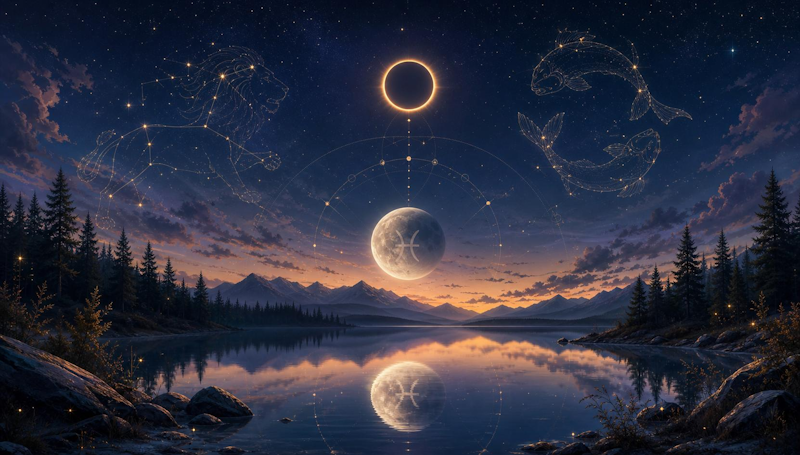
- A calm lake under the full moon.
Each reflection reveals something about the Sun. We recognise its brightness and the presence of sunlight.
But none of these reflections is the Sun.
The river may distort its reflection through movement. Muddy water may obscure it. The water in our palm may provide only a tiny image.
The condition of the reflecting medium changes the appearance, but it does not change the Sun.
This simple observation offers a powerful analogy for understanding consciousness.
2. Atma, Sunlight, Moon and Mind
Let us explore this relationship through four elements.
The Sun – Atma
The Sun represents Atma, the source of consciousness and reality. It exists independently of the reflections through which we perceive it.
Sunlight – Projection
Sunlight represents the projection or manifestation of consciousness. It makes the source perceptible through its manifestations.
Water – Mind
Water represents the mind, the screen or medium upon which the projection appears.
Moon – Mano Karaka
The Moon represents Mano Karaka, the witnessing and reflecting principle associated with the mind.
Both the Moon and the mind remain as witnessing and reflecting elements in this analogy. The appearance of a particular reflection does not determine their existence.
The experiences arising from this relationship include thoughts, emotions, memories, visions, sensations of heat and chill, happiness and sorrow.
The central distinction is that the source, the reflecting medium and the experience are not the same thing.
3. Understanding the three states of consciousness
Consider another analogy: a cinema.
An actor performs a role. That performance is recorded as a movie. Later, the recorded movie is projected onto a screen and watched. When the movie ends, the screen becomes empty.
The actor, the recording and the screen are not identical.
This gives us a way to interpret the three states of human experience.
Jagrat – The waking state
The actor performs the art.
The experience is manifested and recorded as a movie. We interact with the external world through our senses, thoughts and actions.
Svapna – The dream state
The actor watches the recorded movie projected onto the mind-screen.
Experiences arise internally through memories, impressions, thoughts and emotions.
Sushupti – The deep sleep state
The movie has ended. The screen is empty.
There is no ordinary dream projection, but in this philosophical analogy, the actor and the mind continue to exist.
The important observation is that the disappearance of the movie does not mean the disappearance of the actor or the screen.
Manifestation may cease without implying that its source has ceased to exist.
4. Intelligence is not the movie
We generally understand intelligence through logical reasoning, memory, information processing, pattern recognition and problem-solving.
These are measurable expressions of cognitive capability.
But is intelligence limited to the ability to produce and process thoughts?
Consider watching a movie. The characters experience happiness, fear, anger, love and sorrow. The story continuously changes, but the person watching it is not the story.
Similarly, thoughts and emotions continuously arise in the mind. The witnessing principle is not necessarily identical to the content being witnessed.
Perhaps intelligence needs to be explored beyond the processing of information, towards the capacity to witness and understand the manifestations of consciousness.
This is a philosophical proposition, not an established scientific definition of intelligence.
5. Science, doctrines and the reflections of reality
Science is an evolving method of understanding nature. Doctrines are evolving frameworks of philosophical and spiritual interpretation.
Both can provide meaningful insights. Both can also become limitations when we mistake their explanations for the ultimate reality.
The reflection of the Sun in a river is not false. It genuinely reveals something about the Sun. But it is not the Sun.
Likewise, scientific discoveries, philosophical doctrines and personal experiences may reveal different aspects of reality.
We should neither dismiss these reflections nor mistake them for the source.
6. Artificial Intelligence and the future of human intelligence
Humanity developed science to understand nature, technology to extend its capabilities and artificial intelligence to extend its intellectual abilities.
But there is a danger in confusing the processing of information with the understanding of existence.
AI can process enormous amounts of information, recognise patterns and generate sophisticated responses.
However, the ability to produce an intelligent response does not, by itself, establish subjective consciousness or witnessing experience.
The challenge for humanity is not simply to build increasingly intelligent machines. It is to understand intelligence more deeply without surrendering our own ability to question, observe and discover.
This is where Mixed Intelligence becomes meaningful: human intelligence and artificial intelligence should complement each other, not make human curiosity and independent thinking redundant.
7. A journey beyond reflections
Perhaps our journey towards understanding reality should begin with a simple discipline:
- Do not mistake perception for reality.
- Do not mistake knowledge for wisdom.
- Do not mistake the mind’s thoughts for the witness.
- Do not mistake a reflection for its source.
- Do not mistake an explanation for the truth it attempts to explain.
The Sun does not depend on the river to exist. The reflection depends on the Sunlight and the reflecting medium.
Likewise, perhaps consciousness is much more fundamental than the thoughts, emotions and experiences through which we attempt to understand it.
A thought to contemplate
The movie changes. The screen remains. The reflection changes. The Sun remains.
What we experience may come and go, but does the source of experience ever disappear?
The purpose of learning is not merely to collect more reflections. It is to continue questioning until we understand the relationship between the reflection, the medium and the source.
Harivulagam – Exploring the relationship between science, philosophy, consciousness and the mystery of existence.
Learning to question. Questioning to understand. Understanding to evolve.
Leave a Reply